ABS+PC Luggage Production Techniques and Manufacturing Processes Luggages are indispensable essentials for our travels. Suitcases made from an ABS+PC blend have become widely popular among consumers due to their lightweight nature, attractive appearance, excellent impact resistance, and high cost-performance ratio. So, how exactly are ABS+PC suitcases manufactured? What processes are involved—from the procurement of raw materials to the final packaging of the finished product? This guide will detail the production process, covering stages such as production preparation, raw material processing, shell molding, component installation, quality inspection, and final packaging and shipment.
I. Understanding the Material Characteristics of ABS+PC Luggages Before manufacturing a suitcase, it is essential to understand the fundamental properties of the two plastic materials involved: ABS and PC. ABS is a common engineering plastic known for its excellent processability, high rigidity, and superior surface finish. Suitcases made from ABS offer great molding versatility, allowing for a wide range of colors and diverse surface textures, all while keeping production costs relatively manageable. PC, or polycarbonate, is characterized by its high toughness, strong impact resistance, and good heat resistance. Compared to using ABS alone, the inclusion of PC enhances the suitcase shell’s resistance to deformation and cracking when subjected to impact. ABS+PC suitcases are designed and manufactured by combining the strengths of both materials. Furthermore, since PC is generally more expensive than ABS, blending the two can help optimize production costs. It is important to note that ABS+PC suitcases on the market are not necessarily made by simply mixing the two raw materials; they may also be constructed using composite sheets, co-extruded materials, multi-layered structures, or by applying a PC film overlay. The specific manufacturing process is determined by the product design, material formulation, and available luggage making machine on the production line.
II. Raw Material Procurement and Production Preparation The production of ABS+PC Luggage begins with the procurement of raw materials. Manufacturers must select the appropriate ABS and PC resins—or corresponding composite materials—based on the product’s intended market positioning, dimensions, color, strength requirements, and cost budget. In addition to the materials for the suitcase shell, production also requires various components, including telescopic handles, swivel wheels, zippers, combination locks, carrying handles, interior lining fabric, dividers, screws, and other connecting hardware. Although these accessories are small in size, they directly influence the user experience and the overall quality of the luggage. Upon the arrival of raw materials at the factory, the procurement and quality inspection departments must verify the material’s model, color, appearance, packaging, and relevant quality certifications. For plastic raw materials, specific attention should also be paid to properties such as flow characteristics, impact resistance, and processability. Before formal production begins, the factory must establish a production plan, confirming order quantities, product specifications, mold status, equipment parameters, and delivery timelines. Simultaneously, technical staff must prepare product blueprints, process documentation, and quality inspection standards to ensure that subsequent production adheres to consistent requirements.
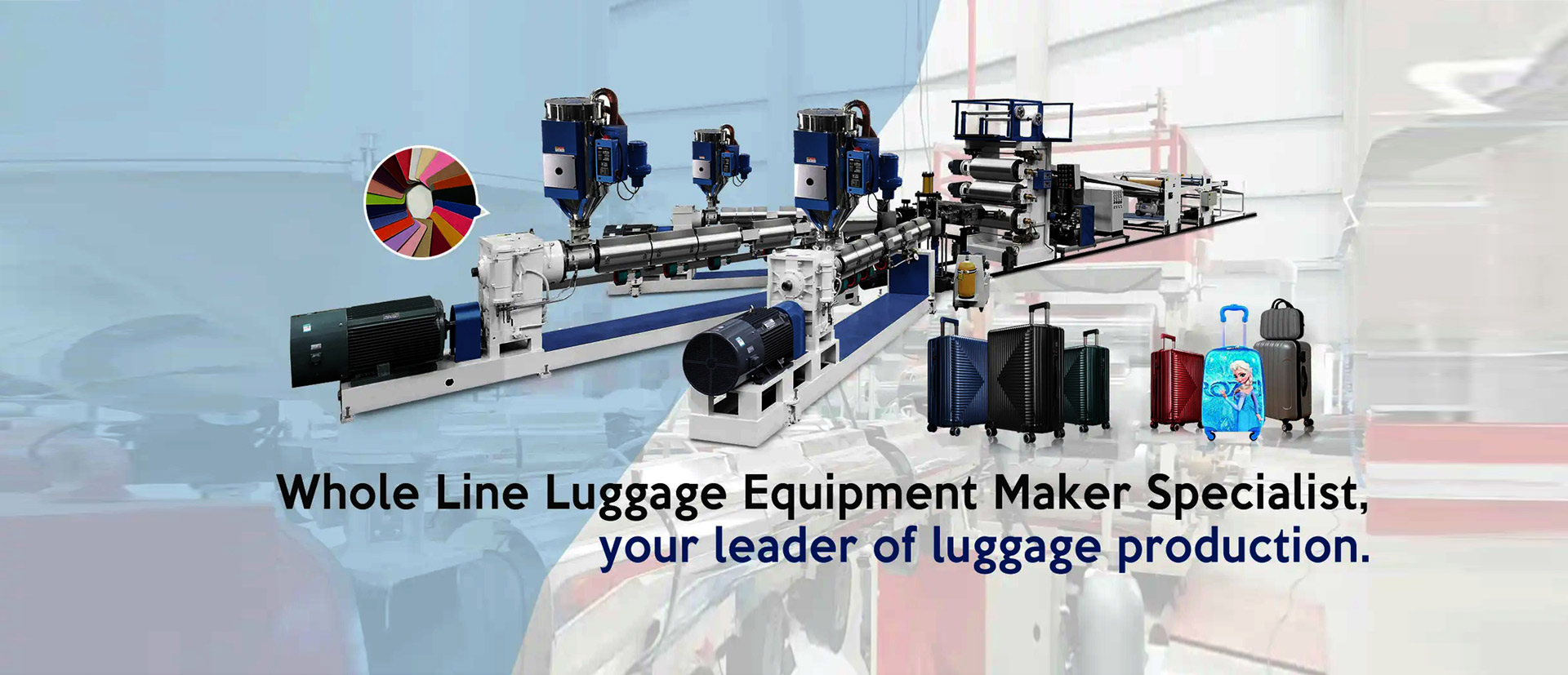
III. Processing and Molding of the Luggage Shell The molding of the luggage shell is one of the most critical stages in the production of ABS+PC luggage; it directly determines the shell’s dimensions, appearance, thickness, and structural integrity. Common manufacturing methods for luggage shells include plastic sheet thermoforming, as well as other processes such as extrusion or lamination, depending on the specific materials and product structure. A full set of reliable luggage making machine is the core guarantee for stable shell forming and consistent product quality.
When the sheet thermoforming process is used, it typically involves the following steps: First, sheet preparation. ABS+PC composite sheets are produced using a sheet extrusion machine. If the PC raw material used is highly hygroscopic, it must first be dried according to the supplier’s specifications to minimize the impact of moisture on processing quality. Second, heating and softening. The plastic sheets are fed into heating equipment until they reach a temperature suitable for molding. The heating temperature and duration must be adjusted based on the material type, sheet thickness, and equipment capabilities. Insufficient heating may prevent the sheet from conforming properly to the mold, while excessive heating can lead to surface defects, localized thinning, or a degradation of material properties. Third, molding. The heated, softened sheet is placed onto a mold. Through vacuum suction, applied pressure, or other appropriate methods, the sheet is pressed against the mold surface to form the basic shape of the luggage’s upper lid and lower body. The mold itself must be pre-designed to define the shell’s dimensions, corner radii, surface textures, and structural reinforcements. Fourth, cooling and setting. Once the shell is formed, it must undergo controlled cooling to allow the material to stabilize into its intended shape. Uneven cooling can lead to warping, inconsistent shrinkage, or dimensional inaccuracies. Fifth, trimming and finishing. A CNC trimming and punching machine is used to remove excess material from the edges of the formed shell and to punch holes for various components, ensuring the shell meets the requirements for subsequent assembly.
Following these steps, the shell is essentially formed; however, it must still undergo surface inspection, dimensional verification, and any necessary post-processing before it can proceed to the next stage of production.
IV. Component Installation and Final Assembly Once the shell has been processed, it moves to the component installation and final assembly stage. In this phase, the shell is integrated with parts such as the telescopic handle, wheels, zippers, combination locks, carrying handles, and interior lining to create a complete piece of luggage. First, the telescopic handle system is installed according to the product’s structural design. This system typically consists of metal tubing, a telescoping mechanism, a release button, and mounting brackets. During installation, it is essential to ensure the handle is securely fixed and extends and retracts smoothly; checks are also performed to ensure there is no excessive wobbling, sticking, or failure of the locking mechanism. Next, the swivel wheels or other wheel assemblies are installed. As wheels are critical to the luggage’s mobility, the installation process includes verifying that the wheel mounts are secure, the wheels rotate freely, and all wheels are aligned at a consistent height. For models with dual-wheel sets, it is also necessary to check for any interference between the wheels or the presence of abnormal noise. Subsequently, components such as zippers, combination locks, and carrying handles are attached. Zippers must open and close smoothly, with the teeth meshing correctly. Combination locks are installed and tested for proper functionality. Carrying handles must be securely anchored to withstand the stress of lifting and carrying. Finally, the upper and lower shell sections are joined together, and the interior lining, dividers, storage straps, and other internal features are installed. The lining should be smooth and free of wrinkles, with sturdy stitching; the placement of dividers and storage straps must strictly adhere to the product’s design specifications. Finally, check that the suitcase opens and closes smoothly, the edges on both sides are aligned, the locks function correctly, and all components are properly installed.
V. Quality Inspection and Performance Testing Quality inspection is a crucial step in ensuring the stability of ABS+PC luggage. Even if a suitcase has an attractive appearance, issues such as a tendency for the shell to crack, a retractable handle that fails to extend or retract, or wheels that malfunction after a period of use can severely negatively impact the consumer experience. Therefore, manufacturers must establish a comprehensive quality inspection system, typically covering three stages: raw material inspection, in-process inspection, and finished product inspection. Finished product inspection includes the following:
- Appearance Inspection: Check for defects such as cracks, visible scratches, stains, deformation, or color inconsistencies on the suitcase shell.
- Dimensional Inspection: Measure the height, width, and thickness of the suitcase, as well as other structural dimensions, to ensure they meet product specifications.
- Retractable Handle Testing: Repeatedly extend and retract the handle to verify smooth operation and reliable locking.
- Wheel Testing: Evaluate the rotation, steering, and rolling performance of the wheels, checking for any looseness, unusual noises, or jamming.
- Lock Testing: Verify the opening and closing functions of combination locks, zipper locks, and any other locking mechanisms.
- Structural Strength Testing: Conduct appropriate strength tests on critical areas—such as the shell, handles, handle attachment points, and wheel housings—in accordance with product standards.
- Durability Testing: Perform rolling, drop, impact, or other durability tests based on client requirements and applicable standards.
For products requiring laboratory testing, inspections must also be conducted in compliance with the regulatory requirements of the target market, client-specific standards, and relevant testing methodologies. Through these tests, factories can promptly identify issues arising during production and make improvements to material selection, mold design, processing parameters, assembly techniques, and the configuration of luggage making machine, thereby enhancing the overall quality of the product.
VI. Packaging, Warehousing, and Shipment Once the luggage has passed quality inspection, it proceeds to the packaging stage. First, staff must clean the surface of the suitcase to remove any dust or residue left over from the manufacturing process. Next, apply or retain protective films as required by the product specifications, and utilize protective bags, foam materials, corner protectors, or other cushioning elements to minimize the risk of scratches, impacts, or crushing during transit. Subsequently, place the luggage into a shipping carton, ensuring that any required documentation—such as instruction manuals, warranty cards, product labels, or other supplementary items—is included in accordance with the order specifications. Once packed, verify that the product model, color, size, barcode, and external carton markings all align with the order details. For bulk orders, the warehousing department must also manage inventory counts, batch records, and outbound logistics to ensure that the actual quantity shipped matches the order requirements. Prior to transport, organize the stacking and loading configuration appropriately to reduce the likelihood of packaging damage or harm to the products during transit.